Alice Liu came to our class to preach the benefits of information and communication technologies in the world of banking, particularly in e- and m-banking for those in the developing world. While the benefits and possibilities of e- and m-banking in the developing world are many, perhaps most fundamentally important is the potential for women in often rural communities to experience a greater deal of control over their own lives, and garner greater respect and ultimately equality within their community. Along with allowing those poor in the developing world to lift themselves out of poverty and maintain safe and legitimate banking accounts, electronic banking gives women a power and responsibility that would perhaps otherwise remain predominantly within the family and home.
Banks are not found in many rural areas of the developing world. Banks tend to be unwilling to offer accounts to the poor as they can be unable to maintain a mandatory minimum amount in their account, lacking a steady stream of income to ensure the bank’s borrowing capability. As we read in Wyeth’s 2010 blog/report from the Mobile Money Summit, while corporations may understand they need to market to the “base of the pyramid” few understand how to do so effectively, and regulators (particularly in the world of finance) care first about stability, and only then about inclusion. Banks therefore continue their reluctance in providing services to the poor in the developing world.
Without banks, the options are few and risky for poor people in the developing world to store or send their own money. Individuals need to find trustworthy couriers to take their money elsewhere (who may want a fee, turn out not to be so trustworthy after all, etc.). Or they can take the funds individually via personal travel (often on foot) but this can take time – and in so doing decrease the individual’s earning potential for the hours, or days that they are in transit. Also, as always, the possibilities that an individual could be robbed or otherwise lose their funds in transit is a distinct possibility, especially in relatively rural and off-the-grid areas.
With the rapid spread of electronic finance, somewhat safer options have emerged. In Latin America particularly, correspondent agents who work at a local shop like a gas or bus station are able to provide the service of depositing and withdrawing money as a bank would. These agents are hooked up to mobile operators or to actual banks in other locations, and such operations are multiplying, as they are less risky for the operators than opening a traditional bank branch.
Mobile phones and m-finance have also allowed for breakthroughs in not only how banking is done by the relatively poor in the developing world, but also in how they do business. Montez and Goldstein remark in their 2010 article on Tanzania for the Africa Development Research Project that most users of m-finance are recent adaptors (3) and that by far the top reason for not using m-finance services was simply a lack of knowledge about how to do so – not a lack of desire (4). These are promising signs for mobile finance in Tanzania in particular, and the developing world as a whole. As the poor and relatively disconnected become more familiar with m-finance through the explosion of mobile-phone availability in the last few years, surely this trend will increase.
As Heeks et al. make clear in The impact of mobile telephony, reducing the presence of intermediaries in small business operations is fundamentally essential to better functioning on both the supply end of things as well as for the eventual producers. Using the case study of the aso oke weavers in Nigeria, this report showed that while intermediaries still remain powerful within the trade (and perhaps more necessary due simply to the geographic distances often separating suppliers from small business people), mobile phones have saved a massive amount of time and money by substituting for personal travel that used to be required of large suppliers, merchants, and the artisans themselves (57).
While the mobile network may have actually entrenched the role of intermediaries and middle-men, m-finance has allowed a new type of intermediary to emerge – the “coordinator weaver” who builds a larger network of weavers and can connect them to a broader array of suppliers and sources of material (58). While middlemen continue to be a drain on the fundamental supply-demand chain of the aso oke weavers, there is also a great deal of hope for how m-finance in particular can be taken advantage of to benefit the suppliers and artisans.
At this point in time, through programs like M-PESA in Kenya, G-Cash in the Philippines or EasyPaisa in Pakistan, billions of dollars have been transferred electronically, with millions of participants in the developing world alone. From relatively simple uses such as depositing and withdrawing money from separate locations, or sending it to family and friends geographically separated from the source, electronic finance has grown to include some very hopeful trends. Among these new uses for electronic finance in the developing world are opportunities to safely pay bills (avoiding the utility cost of lost time), send international remittances in Kenya and Pakistan, and receive one’s government salary and social welfare payments in India and Brazil amongst other countries. Also life and weather insurance have been provided via electronic financing through M-PESA and other programs in developing nations.
However before traditional banks and banking services get entirely involved with e-finance in many particularly rural and underdeveloped villages and regions of the developing world, the basic money exchanges and withdrawals as well as transport will still need to be done with a great deal of support and participation from local people.
Utilizing an already-trusted person in the community to provide leadership, responsibility, and oversight to the processes is essential to a well-functioning financial hub in any village or small town. And throughout much of the developing world, the respect and cultural importance of women offers an intriguing opportunity to broaden the social, political, and especially financial roles and responsibilities of women. Uplifting the status of women is possible through e-finance, and as Liu made clear, once a woman became the central financial hub of her community (operating a trading kiosk of sorts) her status was automatically lifted. As the great John Legend says, Let’s get lifted.
So Let It Be Written, So Let It Be Done
In Blog We Trust: Chronicling 'America's Changing Faces' for Cornell's Summer in Washington 2011.
Saturday, July 23, 2011
Thursday, July 14, 2011
Obama's Open Government Directive & Technological Citizenry
To paraphrase this week's class section subtitle, today I hope to explore the potential of new technologies to strengthen America's democracy, government transparency and accountability.
There seems to be a growing body of evidence to suggest that citizen participation and knowledge of government programs (essential for a participatory citizenry) is growing, and technologies like the Internet and mobile phones have improved true transparency and accountability. President Obama's noble pledge in the Open Government Directive on his first day in office defines the transparency, participation and collaboration of and with government as the cornerstone principles of an open government. Through promoting accountability by providing more information, allowing citizens to have a larger eVoice in the process of government, and encouraging partnerships across the levels of government and with private institutions, the President is making good on his word.
Our new friend Aaron Smith from PEW compiled two studies from last year that help to support the idea that participatory democracy is enabled and enhanced through new technologies. Compared with the 64% of the general population who reported voting in the 2010 elections, 71% of mobile phone owners did so (Politics Goes Mobile 2010). While the data itself (as opposed to self-reporting by citizens) suggests that the overall population turnout was closer to 40%, it is unclear whether mobile phone owners are simply more adept or inclined to lie to pollsters or whether they did actually vote more, but I am willing to give them the benefit of the doubt on this one. Access to government information and program activities is a bit less controversial to chart, and increasing public knowledge should ideally lead to greater political involvement, including voting.
As such, Smith reveals that 82% of Internet users (representing 61% of all American adults) looked for information or completed a transaction on a government website in the twelve months preceding the next PEW survey (Government online 2010). While this is certainly encouraging in and of itself, Americans are not simply using the Internet to process bureaucratic forms or pay taxes but are also tuning in on specific policies and legislation. For example, 48% of Americans have looked for information on a particular public policy or issue online, and 46% have looked up what services a given government agency provides to the public (Ibid.). While all of this increased knowledge and access to policy goals and agency benefits is a sure victory for informing, educating, and inspiring citizens, what is most impressive is that according to the survey Americans generally accomplish most or all of what they want to do on government sites.
On a participatory level, new technologies have enabled everyday citizens to have another life-line to their elected officials, whether through electronic mail or SMS and social media communication with officials, candidates, or political campaigns. Additionally, Americans are not ceasing their activities after simply gaining more information on government activities - increasingly they are voicing their opinions on what they've learned. Of Internet users, 23% participate in the online debate about government policies and issues, and much of of this discussion occurs outside the official and traditional government channels (Government Online 2010). What Smith terms, "online government participators" are a growing and vocal group of Americans, and are going a long way to realizing Obama's goals of ensuring a seat at the electronic table for citizens to provide feedback on government's activity.
While it is not as easy to see the immediate effects of Obama's planned collaboration between federal, state and local governments as well as with private institutions and its direct impact on American citizens, Obama's stimulus bill is a prescient example of such interconnectedness. Whether a certain segment of the American people believe that this arguable expansion of "big government" into the lives of citizens is a positive or a negative (and I would argue the former over the latter), Smith makes clear that 40% of online Americans have sought out data on the business of government, and 23% have explored the government's use of the stimulus money in particular (Government online 2010). This increasing skepticism and inquiry into the expansion of government - especially at the state and local levels - is an important indicator that American citizens are getting involved in the business of government at the source and the periphery and ultimately ensuring a more informed and impassioned voting populace.
While the Obama administration - and subsequent ones - certainly have a long way to go towards reaping the benefits of a technologically connected and collaborating American public, the Open Government Directive has been a good start. As government makes itself more transparent and contactable, citizens' interest and participation will only continue to increase, and as Smith and PEW make clear, this trend is on the rise election cycle to election cycle. With more Americans online than ever before - and many getting in touch with government via social media and SMS as well - we are becoming a more knowledgeable, engaged, and ultimately effective democracy.
When more voices are heard and responded to, a truly representative government can result and as long as Washington remains open to criticism and suggestion, this government can realize the goals that Lincoln so eloquently expressed at Gettysburg in 1863, one "of the people, by the people, for the people..."
There seems to be a growing body of evidence to suggest that citizen participation and knowledge of government programs (essential for a participatory citizenry) is growing, and technologies like the Internet and mobile phones have improved true transparency and accountability. President Obama's noble pledge in the Open Government Directive on his first day in office defines the transparency, participation and collaboration of and with government as the cornerstone principles of an open government. Through promoting accountability by providing more information, allowing citizens to have a larger eVoice in the process of government, and encouraging partnerships across the levels of government and with private institutions, the President is making good on his word.
Our new friend Aaron Smith from PEW compiled two studies from last year that help to support the idea that participatory democracy is enabled and enhanced through new technologies. Compared with the 64% of the general population who reported voting in the 2010 elections, 71% of mobile phone owners did so (Politics Goes Mobile 2010). While the data itself (as opposed to self-reporting by citizens) suggests that the overall population turnout was closer to 40%, it is unclear whether mobile phone owners are simply more adept or inclined to lie to pollsters or whether they did actually vote more, but I am willing to give them the benefit of the doubt on this one. Access to government information and program activities is a bit less controversial to chart, and increasing public knowledge should ideally lead to greater political involvement, including voting.
As such, Smith reveals that 82% of Internet users (representing 61% of all American adults) looked for information or completed a transaction on a government website in the twelve months preceding the next PEW survey (Government online 2010). While this is certainly encouraging in and of itself, Americans are not simply using the Internet to process bureaucratic forms or pay taxes but are also tuning in on specific policies and legislation. For example, 48% of Americans have looked for information on a particular public policy or issue online, and 46% have looked up what services a given government agency provides to the public (Ibid.). While all of this increased knowledge and access to policy goals and agency benefits is a sure victory for informing, educating, and inspiring citizens, what is most impressive is that according to the survey Americans generally accomplish most or all of what they want to do on government sites.
On a participatory level, new technologies have enabled everyday citizens to have another life-line to their elected officials, whether through electronic mail or SMS and social media communication with officials, candidates, or political campaigns. Additionally, Americans are not ceasing their activities after simply gaining more information on government activities - increasingly they are voicing their opinions on what they've learned. Of Internet users, 23% participate in the online debate about government policies and issues, and much of of this discussion occurs outside the official and traditional government channels (Government Online 2010). What Smith terms, "online government participators" are a growing and vocal group of Americans, and are going a long way to realizing Obama's goals of ensuring a seat at the electronic table for citizens to provide feedback on government's activity.
While it is not as easy to see the immediate effects of Obama's planned collaboration between federal, state and local governments as well as with private institutions and its direct impact on American citizens, Obama's stimulus bill is a prescient example of such interconnectedness. Whether a certain segment of the American people believe that this arguable expansion of "big government" into the lives of citizens is a positive or a negative (and I would argue the former over the latter), Smith makes clear that 40% of online Americans have sought out data on the business of government, and 23% have explored the government's use of the stimulus money in particular (Government online 2010). This increasing skepticism and inquiry into the expansion of government - especially at the state and local levels - is an important indicator that American citizens are getting involved in the business of government at the source and the periphery and ultimately ensuring a more informed and impassioned voting populace.
While the Obama administration - and subsequent ones - certainly have a long way to go towards reaping the benefits of a technologically connected and collaborating American public, the Open Government Directive has been a good start. As government makes itself more transparent and contactable, citizens' interest and participation will only continue to increase, and as Smith and PEW make clear, this trend is on the rise election cycle to election cycle. With more Americans online than ever before - and many getting in touch with government via social media and SMS as well - we are becoming a more knowledgeable, engaged, and ultimately effective democracy.
When more voices are heard and responded to, a truly representative government can result and as long as Washington remains open to criticism and suggestion, this government can realize the goals that Lincoln so eloquently expressed at Gettysburg in 1863, one "of the people, by the people, for the people..."
Thursday, July 7, 2011
Doctors truly without borders (or plane tickets)
Mobile health (mHealth) expert Jody Ranck made some excellent points this week, and with time comes internalization and synthesis - so hopefully this week's blog can organize some of his thoughts with my own and produce a new idea for medical services in the developing world. Or at the very least spruce up an old idea.
In an age when a smart phone's camera can send a digital image clear enough for a doctor on the other side of the world to accurately diagnose skin conditions, or an eye scanning device for under $100 attached to the same smart phone can give any patient an accurate prescription (thanks MIT) without necessitating the purchase of a $100,000 phoropter, many wonder if we still need doctors in the traditional sense.
Many of the most needed and life saving surgeries in the developing world require only modest training a few years past high school, and nurses and their associates can be supremely useful and priceless when and where doctors are decidedly lacking. Particularly in the developing world, where medical training in general - and doctors in particular - are in low supply and high demand, it makes a great deal of sense to abandon the West's rigid interpretation that to be a "doctor" one must have spent a decade (or more) and up to hundreds of thousands of dollars in the Academy. Yet to devalue doctors, whether in the first or the third world (and everywhere in between) is to do not only the profession and its practitioners, but also the societies they practice in a grave disservice.
Coming from a major medical family - my Dad is an MD and my Mom, among other things, a registered nurse - might give me a pro-doctor bias. However it also gives me a window into the world of the classically trained health professional. I know firsthand the wild and profound knowledge great health care professionals (and perhaps especially MDs) have at their disposal at all times. Countless times I have made use of just such knowledge for my own selfish aims. My parents are generally able to quickly - and accurately - answer my health related questions and even on occasion diagnose my woes. A relatively unromantic bout of likely food poisoning comes to mind as the latest example (thanks Bonnaroo 2010!).
While the years and dollars spent acquiring such knowledge (and degrees) may be more worth it to some than others - however they define that "worth" - the knowledge and skills that doctors and other medical professionals learn and practice over years are profoundly important and irreplaceable. At the end of the day I don't know a single person who would prefer we lived without such vital human resources, or would rather diagnose themselves or a loved one than get the best medical advice they could from a professional.
However, as with many elements of this, our New World, technology and the increasing interconnectedness of people across vast distances and economic barriers must elicit changes in how we view the medical profession - and doctors in particular.
Perhaps gone are the days when the only people to turn to are women and men in long white lab-coats with stethoscopes hanging around their necks. Instead of referring only to the MDs - especially in the developing world where they are too few and far between - people must seek other alternatives, but I would argue they must be connected to and communicating with doctors. This is where the future lies - doctors as references and ideal resources for those with less experience, or ability to get the same education that the top-notch university systems provide. Instead of either relying on outdated and incomplete medical information or turning patients away due to a lack of material and experience-based resources, we must connect classically trained doctors with those aspiring to provide fundamental medical treatments where doctors are not available.
Global technology and communication systems provide an intriguing and elemental connection here - we must encourage and ideally incentivize doctors to reach out and give their time and knowledge to those in the developing world who are eager to learn and help the sick in their own communities. Whether this means having doctors send SMS messages from hospitals and universities to health care providers across the globe or instituting web-based platforms whereby medical questions and problems can be quickly asked and answered seems relatively unimportant. In fact that has been a profound lesson of this class - the specific technology used is less important than the fact that technology is merely a means to the end of meaningfully connecting people throughout the world. Whether medical instructors and practicing doctors spend their weekends communicating with those in need of assistance or retired MDs take some time out of their post-career lives to do the same is also relatively inconsequential. The fundamental medical skills and knowledge that so many doctors possess does not fade with time - nor does their interest in helping others be well.
Ultimately then this is a call to arms - for doctors and nurses, medical teachers and students alike - to get involved beyond their own hospitals or universities. Whether they travel bodily to a developing nation to help the sick and heal the injured is not as important as that they do get involved and communicate with interested parties abroad. We can no longer afford to heal our own at the expense of the global sick - and thanks to advances in communications technologies, perhaps we won't ever have to again. One doctor's medical knowledge belongs not to that individual, her/his practice or clinic, nor even to their nation.
In an age when a smart phone's camera can send a digital image clear enough for a doctor on the other side of the world to accurately diagnose skin conditions, or an eye scanning device for under $100 attached to the same smart phone can give any patient an accurate prescription (thanks MIT) without necessitating the purchase of a $100,000 phoropter, many wonder if we still need doctors in the traditional sense.
![]() |
| Is this a better choice in the developing world than an iPhone? |
Many of the most needed and life saving surgeries in the developing world require only modest training a few years past high school, and nurses and their associates can be supremely useful and priceless when and where doctors are decidedly lacking. Particularly in the developing world, where medical training in general - and doctors in particular - are in low supply and high demand, it makes a great deal of sense to abandon the West's rigid interpretation that to be a "doctor" one must have spent a decade (or more) and up to hundreds of thousands of dollars in the Academy. Yet to devalue doctors, whether in the first or the third world (and everywhere in between) is to do not only the profession and its practitioners, but also the societies they practice in a grave disservice.
Coming from a major medical family - my Dad is an MD and my Mom, among other things, a registered nurse - might give me a pro-doctor bias. However it also gives me a window into the world of the classically trained health professional. I know firsthand the wild and profound knowledge great health care professionals (and perhaps especially MDs) have at their disposal at all times. Countless times I have made use of just such knowledge for my own selfish aims. My parents are generally able to quickly - and accurately - answer my health related questions and even on occasion diagnose my woes. A relatively unromantic bout of likely food poisoning comes to mind as the latest example (thanks Bonnaroo 2010!).
![]() |
| Make sure to adequately cook all raw meat. Refrigerating it is also a plus. |
While the years and dollars spent acquiring such knowledge (and degrees) may be more worth it to some than others - however they define that "worth" - the knowledge and skills that doctors and other medical professionals learn and practice over years are profoundly important and irreplaceable. At the end of the day I don't know a single person who would prefer we lived without such vital human resources, or would rather diagnose themselves or a loved one than get the best medical advice they could from a professional.
However, as with many elements of this, our New World, technology and the increasing interconnectedness of people across vast distances and economic barriers must elicit changes in how we view the medical profession - and doctors in particular.
Perhaps gone are the days when the only people to turn to are women and men in long white lab-coats with stethoscopes hanging around their necks. Instead of referring only to the MDs - especially in the developing world where they are too few and far between - people must seek other alternatives, but I would argue they must be connected to and communicating with doctors. This is where the future lies - doctors as references and ideal resources for those with less experience, or ability to get the same education that the top-notch university systems provide. Instead of either relying on outdated and incomplete medical information or turning patients away due to a lack of material and experience-based resources, we must connect classically trained doctors with those aspiring to provide fundamental medical treatments where doctors are not available.
Global technology and communication systems provide an intriguing and elemental connection here - we must encourage and ideally incentivize doctors to reach out and give their time and knowledge to those in the developing world who are eager to learn and help the sick in their own communities. Whether this means having doctors send SMS messages from hospitals and universities to health care providers across the globe or instituting web-based platforms whereby medical questions and problems can be quickly asked and answered seems relatively unimportant. In fact that has been a profound lesson of this class - the specific technology used is less important than the fact that technology is merely a means to the end of meaningfully connecting people throughout the world. Whether medical instructors and practicing doctors spend their weekends communicating with those in need of assistance or retired MDs take some time out of their post-career lives to do the same is also relatively inconsequential. The fundamental medical skills and knowledge that so many doctors possess does not fade with time - nor does their interest in helping others be well.
We must encourage any and all doctors to get involved and - with or without discernible reward or recognition - to get in touch with a program or an individual community in need of guidance and inspiration. While programs like Doctors Without Borders are wonderful, if troubled, realizations providing medical resources and doctors to the developing world, they seem a somewhat misguided solution. Instead of merely exporting medical talent and aspiration abroad, we must actively encourage its growth at the source. By providing information and medical skills remotely, home-grown medical professionals and semi-professionals can increase their own skill sets and desire to continue the everlasting quest of profound medical knowledge. This is not to degrade such programs or to suggest that only by "providing" medical insight and knowledge will a developing nation develop its own medical infrastructure - I am extremely uncomfortable hearing the post-colonial alarm bells ringing in my own head. This is only to say that classically trained doctors can be useful beyond their small locales and borders - they can provide meaningful benefits to people throughout the world. Western medicine may be no better or productive than local remedies (although I would say it is - but that's the seed for another, somewhat more controversial, blog), but in a field like medicine don't we need all the knowledge and training we can muster to help individuals in need of attention and health?
![]() |
| You know you like them. |
Ultimately then this is a call to arms - for doctors and nurses, medical teachers and students alike - to get involved beyond their own hospitals or universities. Whether they travel bodily to a developing nation to help the sick and heal the injured is not as important as that they do get involved and communicate with interested parties abroad. We can no longer afford to heal our own at the expense of the global sick - and thanks to advances in communications technologies, perhaps we won't ever have to again. One doctor's medical knowledge belongs not to that individual, her/his practice or clinic, nor even to their nation.
Medical knowledge and above all health is a public and global good - and it is morally indefensible not to treat it as such.
Friday, July 1, 2011
For the Love of Teachers
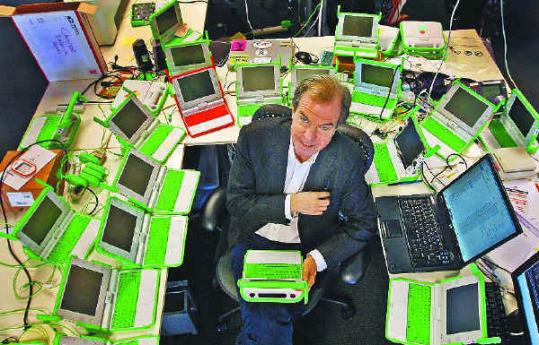
The notion of providing every child in the world - particularly the developing world - with a laptop at low cost or ideally free of charge through national and international initiatives is a wonderful one.
But I break with Nicholas Negroponte and his One Laptop per Child program on a few key issues.
![]() |
| The Man Himself |
![]() |
OLpC Program in Nigeria |
Secondly, when these laptops break down physically or their software malfunctions, children need teachers who have training on computer repair and maintenance. Too often these One Laptop per Child machines seem to be abandoned when they no longer perform adequately - which both robs the student of a machine that inspires and enables creativity and technological learning as well as shows inter/national organizations that their often extensive funding for such a project is misplaced. The only way that the OLpC program can work is for teachers to become computer mechanics, and pass this newfound knowledge onto their students.
Ultimately the issue at the forefront of improving education - especially in the tech world - is what it has always been: discovering how to inspire teachers to become more involved and effective, more knowledgeable and motivated to continue to learn and improve their own teaching methods. As such, Trucano was right to say that "the introduction and use of ICTs in education can be a useful tool to help promote and enable educational reform" (Knowledge Maps 2005) but that reform must be the end we seek in improving education in the developing world and throughout the globe.
To say that simply providing a new piece of technology is the end-all-be-all solution to the problems of the international education systems is to disregard the fact that without guidance and a network of support, technology will only prove as effective as children make it for themselves. Without discounting the wild - and often astonishingly inspirational - learning that students can do for and by themselves, why propose an educational world where teachers lose their place as guides along the trail of learning? Quite cynically, even if only to inspire students that they themselves can be better, more effective communicators and guides than their teachers are, isn't this enough of a reason to provide students with ever-learning and ever-improving teachers in the classrooms of the world?
So, in the end, the conversation over Negroponte's One Laptop per Child program and others of the sort rests with the fate of teachers, not students or children, and not even so much technology. Children will use whatever technology is at their disposal - and increasingly cell phones are bridging the gaps between those in the developing world and the rest. But to simply use a cell phone, or a laptop, is not enough of a victory for those truly passionate about educational reform. We must strive to use these technologies effectively to harness each child's natural fascination with and motivation towards learning. And not necessarily just for the sake of learning itself - when we see farmers using cell phones to make sure they are not cheated at the local market for their goods, or when we see children reading full-length novels and texts on the tiny screens, we are seeing evidence of technology's ability to improve the standard of living and the standard of imagination the world over.
But we can not be satisfied with simply giving a child a laptop and walking away. We must stand with that child and help them, encourage them, and ultimately learn from them.
The world needs great teachers - and local ones at that.
![]() |
| This is a good start - how about evident electricity and local teachers next? |
Thursday, June 23, 2011
The Museum as Temple, and Art as Holy
A place of solitude and introspection, the museum is my temple. While wandering through the halls of the Louvre or the MoMA or the Met we are given the opportunity to experience works of art we never knew before, and to see them in different lights and from different angles. There is no substitute for this physical and immediate experience of comprehending and internalizing visual art, and I will argue that while the digitalization of museums (for my purposes, art museums) has certain and profound benefits, when given the opportunity I would never choose to view art on the internet when I could see it in person. Museums have always been a place of hands-on (or at the very least eyes-on) learning in my life, and as technology allows for the expansion of the museum space from the purely physical and finite world to the more ambiguous sphere of the infinite and digitalized I wonder if the ‘museum experience’ itself is in flux.
Styliani et al. make a few excellent points in regards to the value of virtual museums in their piece, Virtual museums, a survey and some issues for consideration. While the digital sharing process undoubtedly enables the preservation and sharing of fragile artifacts (when a single scan can spread a piece of art to countless eyes for the remainder of the digital age), putting art on the internet also allows for audiences around the world to experience and appreciate the art – especially those who would otherwise be unable to see it. Whether personal geography or economy is the barrier to a museum visit, digitizing and sharing works of art over the Internet broadens the available audience and can inspire those halfway around the world. There is no question this increase in audience size and diversity is a benefit for all within the audience – and for art itself. How are we to broaden the capabilities, complexities, and even definitions of art without spreading the art-bug, as it were, to people all around the world?
For B.J. Soren in Best practices in creating quality online experiences for museum users, the focus was not on defending online museums as such but to enable digitized museums to be more productive and effective in reaching the young in particular. Targeting young users - especially first-time users - is essential to fostering an appreciation for art and history (and their nexus), while at the same time ensuring that professionals and adults remain interested is key to ensure the casual and fanatic fans of art return. Soren found, through rather meticulous research, that instead of focusing on either one target audience or one particular focus of teaching, museums must offer a range of different outlets for people of all ages and experience-levels to further enjoy and learn from the museum piece. Fundamentally important were ideas such as sharing and spreading information, making the reception of art/history more than a simple one-way street by encouraging participation and the exchange of ideas between visitors and educators, and finally inspiring creativity and reflection in regards to any given museum exhibit. The bottom line for Soren was to make sure that particularly children remained interested and engaged – and in the online museum world this could mean anything from virtual games relating to the presented information to prompts to create something new with the information garnered from the museum visit. I very much appreciated that one of Soren’s ultimate concerns was with being sensitive to the needs of the community in which museums operate – both to ensure respect for a given culture as well as to reach out and hopefully ensure that the community itself offers information and creative help to individual exhibits and museums for a richer and more honest presentation of the information at hand.
In addition to our readings, I am reminded of one of the most impacting and inspiring TED talks of recent memory (and, as a TED talk junkie, this is not a claim I make lightly). Amit Sood worked for Google and developed the company's Art Project, and, to make a long story short (and not ruin the glory of Sood's attached talk) the Art Project is an inter-museum approach to digitizing the works of the world's great museums in one place, for all people to access on the Internet. The opportunity for individuals to amass digital collections of their favorite works of art and in some small sense 'own' their experience in this permanent way is one, I think, particularly important gift of the Art Project. Attached is the TED talk, for more information certainly take an adventure at the Art Project's home page.
Both authors and Mr. Sood understand that there are certain limitations to the virtual museum as a locus of presenting (and hopefully inspiring) discussion and history – and I think that at the end of the day virtual museums must “act in a complementary and auxiliary manner” to traditional museums (Styliani et al. 524). So, given all the benefits and wonder of the virtual museum as a learning and teaching tool, why my concern for the loss of the museum-space of old? There are a few tangible (and many more intangible) beauties to the physical museum, and they are the causes I wish to champion.
While the scan of a piece of art may show incredible detail and provide complementary historical information on the piece, its creator, the time period of creation, etc. I truly do not believe that the dimensional experience of a piece of art can be adequately replicated in the digital world.
To see the individual brush strokes and texture of a painting in real-time, right before your eyes is decidedly different than to see the admittedly incredible pixelation of that same piece on the Internet. This connection with the artist, this fundamental connection to human creation, is irreplaceable and missing in the scans of paintings that I peruse online.
The physical settings of the museum space itself add to and complicate the experience of appreciating art. Whether the chairs in front of a piece are comfortable or not impacts how long I will spend appreciating any single item - whether there are chairs at all is certainly a consideration for my achey bones.
Seeing a piece of art (especially one that requires true three-dimensional appreciation as a statue does) from different angles and in different light can have a profound impact on any art lover - another task difficult to replicate with a single scan or even a detailed 3D rendering of a model.
While it is certainly not encouraged in all museums, to touch a piece of art and thereby further limit the philosophical and spatial distance between the creator and the purveyor of art is another benefit not provided by the virtual museum.
It is extremely hard to quantify the visceral reaction of any individual to a piece of visual art - when the contours of the brush strokes strike one under a certain light or angle and one's reaction and response (even a silent one) to others visiting the museum takes hold in an almost uncontrollable way. By means of some (hopefully rare) self-indulgence, I will leave you with my personal experience - the last time I visited an art museum.
In New York with friends for a long weekend about two months ago, we visited the holy of holies, the Museum of Natural History to explore new exhibits and live vicariously through our younger selves by visiting the old. After a leisurely walk across the Park we made our way to the last stop of the day - the sacred Met. While I somewhat anti-socially broke off from our small group to spend some time alone with the pieces that surrounded me (art is to be appreciated communally, perhaps, but internalized in solitude), I walked for some time examining some pieces and barely taking others in. Until I stopped. For whatever reason - maybe drowsiness from a long day of walking the city or slight confusion from some pre-museum imbibing of spirits - I chose to sit down in front of a particular piece.
André Derain's Houses of Parliament at Night (1905-06) took from me the desire to keep walking. This piece, with its haunting colors and historic setting, challenged my motivation to see as much as possible and instilled a deeply peaceful feeling that to take in one piece of art fully - truly fully - was perhaps more desirable than to sneak a glance at every piece on earth.
I spent nearly forty minutes sitting there, in an uncomfortable chair, examining and internalizing every aspect and inch of Derain's work. I took pictures, I contemplated sketches, and, ultimately, I sat in silence hoping that I could someday further reflect on the experience and the moment. To see Houses of Parliament at Night in a digital form would be to do it a disservice - but I will provide it anyway, to give my reader a glimpse of what kept me seated, in an uncomfortable chair, for the better part of an hour.
The museum is my temple, and the self-sacrifice of time pays off a thousand fold when this congregant finds something truly holy. Use virtual museums and scans of art when you are unable to experience the physical alternatives - use them to store and invigorate your most cherished memories - but never forget the simple humility and profound peace of spending some time in the physical presence of the art you love.
Thursday, June 16, 2011
Everybody Has a Story, Let's Start Listening
David Andrew Johnson said that everybody tells a story, and more importantly perhaps, everybody has a story to tell. With 156,000,000 blogs around today (and 50,000 starting daily) it seems that individuals all around the world are quite quickly realizing that they are no different - we all have important stories to tell. The problem (as high blog-abandonment rates suggest) is that bloggers are frustrated that their own blogs - their own stories - don't attract enough immediate attention. Many (perhaps most) choose to stop telling their stories in that forum instead of waiting it out and hoping that others will either become more interested or that they themselves will hone their story-telling skills to the point that others come back for more.
This abandonment issue is certainly an important one for the blogosphere, but I will argue that instead of being merely the byproduct of readers too rushed to tune in, the dissipation of interest (both of the writer and the readers) is the result of downright uninteresting and unimportant stories. How many times can a reader - with limited time and interest - peruse stories about what an individual author's cat did today (or where they went for a walk, or how their classes are going...)?
As the cost of connectivity is still very high, blogs are less available to writers in the developing world - those who possibly have stories more compelling and conspicuous than your average college-educated, self-interested blogger of the developed world. As the cost is higher to access the internet in the developing world (and as Professor Colle made clear last week many in the developing world only have access to computers in telecenters and other community-based and physically finite locations) wouldn't a blogger in such an area take more care to use their internet time effectively and write in a way that cuts through a day's monotony to something truly meaningful - and hopefully universal?
S. Allan and E. Thorsen bring their readers two excellent examples of how citizen journalism and blogging can be meaningful and important - even vital. In The Case of the Wenchuan Earthquake these authors make clear that in a state like China with rigidly controlled and nationalized media (approved by a dictatorial government) not only do "citizen journalists fill the vacuum" (98) of information when emergencies such as the Wenchuan earthquake occur, but in a more generalizable sense, "It seems fair to say that the value of citizen journalism is the greatest when and where the professional media fail" (102).
This second point applies equally well to Human Rights and Wrongs: Blogging news of everyday life in Palestine, also by Allan and Thorsen. While I would never hope to simplify the situation on the ground in the Middle East to something as black-and-white as rights and wrongs, giving the formerly-voiceless a voice is always to be defended and expanded - no matter what side of a debate the reader is on. As surely as I would defend the freedom of speech (even distasteful, hateful speech) in this country, I am unable and unwilling to see in the lines delineating nation states lines of morality that should disallow an individual to express their own beliefs. As internet access has been aggressively limited by Hamas and others in the region, as well as the very real declining economic conditions in Palestine since the al-Aqsa Intifada in 2000 (85), Palestinian blogs are more necessary now than ever.
Those who speak out in regions and nations where protesters are intimidated and silenced deserve respect and defense. Disagreement with an opinion (especially a blog - written perhaps by someone without access to other forms of traditional public communication and speech) is to be equally defended, but disagreement should never result in censorship.
To pretend I could make this point better than the profound John Stuart Mill would be disingenuous and do a decided disservice to those reading - as such I will provide my point via a wordsmith much more meticulous than I am. "...the peculiar evil of silencing the expression of an opinion is that it is robbing the human race, posterity as well as the existing generation - those who dissent from the opinion, still more than those who hold it. If the opinion is right, they are deprived of the opportunity of exchanging error for truth; if wrong, they lose, what is almost as great a benefit, the clearer perception and livelier impression of truth produced by its collision with error" (On Liberty, 1859).
As a firm believer that a two-state solution is the only possible lasting peace the Middle East will see in my lifetime, I am also quick to defend the rights of Israeli nationhood and my fellow Jews in the region. But to stop here would not be enough - for this would be to deny the basic brotherhood (and sisterhood) I share with the people of Palestine as well, and all people seeking safety, security, and a homeland. There is no one among us who is undeserving of these basic rights, and anyone who claims legitimacy based solely on religious grounds or the dictates of a book written between the 12th and 2nd centuries BCE has lost the debate before it can even begin. We are all human beings, all of us destined to enjoy and endure the same moments of happiness as well as those trials and tribulations that are the substance of life. Reading the Blogging news of everyday life in Palestine I am struck by how universal all of our human desires are, and how ludicrous it is that a piece of land (or a particular faith, or an ideology...) should be the source of such intense and continuing division between people.
To return, finally, to David Johnson should no doubt be a relief to those reading, as I fear my own preaching has replaced academic blogging for the time being. One point that he made really struck me - and gave definition to my own academic focus in a way I was previously unable to articulate. Johnson said, justifying his own tendency to offend, that "much of history is quite offensive." Finally it made sense why I've dedicated these years of my life to the study of History and the ongoing pursuit of learning - not to 'know' the facts of the past but to interpret (and reinterpret) them through a continually evolving lens. My roommate asked me today if you can ever be truly "good" at history. I told him that you can only specialize - gaining extraordinary knowledge and insight into a particular figure, or area, or period of time. But that is not my interest, and I sincerely hope never to find satisfaction in knowing even a great deal about a little thing. To be "good" at history is to be forever learning and finding new sources. This is how I should appreciate blogging (both in writing one and reading many). This is how citizen journalists and bloggers can provide meaningful stories that others will want to read - and keep on reading.
And I hope you do.
This abandonment issue is certainly an important one for the blogosphere, but I will argue that instead of being merely the byproduct of readers too rushed to tune in, the dissipation of interest (both of the writer and the readers) is the result of downright uninteresting and unimportant stories. How many times can a reader - with limited time and interest - peruse stories about what an individual author's cat did today (or where they went for a walk, or how their classes are going...)?
As the cost of connectivity is still very high, blogs are less available to writers in the developing world - those who possibly have stories more compelling and conspicuous than your average college-educated, self-interested blogger of the developed world. As the cost is higher to access the internet in the developing world (and as Professor Colle made clear last week many in the developing world only have access to computers in telecenters and other community-based and physically finite locations) wouldn't a blogger in such an area take more care to use their internet time effectively and write in a way that cuts through a day's monotony to something truly meaningful - and hopefully universal?
S. Allan and E. Thorsen bring their readers two excellent examples of how citizen journalism and blogging can be meaningful and important - even vital. In The Case of the Wenchuan Earthquake these authors make clear that in a state like China with rigidly controlled and nationalized media (approved by a dictatorial government) not only do "citizen journalists fill the vacuum" (98) of information when emergencies such as the Wenchuan earthquake occur, but in a more generalizable sense, "It seems fair to say that the value of citizen journalism is the greatest when and where the professional media fail" (102).
This second point applies equally well to Human Rights and Wrongs: Blogging news of everyday life in Palestine, also by Allan and Thorsen. While I would never hope to simplify the situation on the ground in the Middle East to something as black-and-white as rights and wrongs, giving the formerly-voiceless a voice is always to be defended and expanded - no matter what side of a debate the reader is on. As surely as I would defend the freedom of speech (even distasteful, hateful speech) in this country, I am unable and unwilling to see in the lines delineating nation states lines of morality that should disallow an individual to express their own beliefs. As internet access has been aggressively limited by Hamas and others in the region, as well as the very real declining economic conditions in Palestine since the al-Aqsa Intifada in 2000 (85), Palestinian blogs are more necessary now than ever.
Those who speak out in regions and nations where protesters are intimidated and silenced deserve respect and defense. Disagreement with an opinion (especially a blog - written perhaps by someone without access to other forms of traditional public communication and speech) is to be equally defended, but disagreement should never result in censorship.
To pretend I could make this point better than the profound John Stuart Mill would be disingenuous and do a decided disservice to those reading - as such I will provide my point via a wordsmith much more meticulous than I am. "...the peculiar evil of silencing the expression of an opinion is that it is robbing the human race, posterity as well as the existing generation - those who dissent from the opinion, still more than those who hold it. If the opinion is right, they are deprived of the opportunity of exchanging error for truth; if wrong, they lose, what is almost as great a benefit, the clearer perception and livelier impression of truth produced by its collision with error" (On Liberty, 1859).
As a firm believer that a two-state solution is the only possible lasting peace the Middle East will see in my lifetime, I am also quick to defend the rights of Israeli nationhood and my fellow Jews in the region. But to stop here would not be enough - for this would be to deny the basic brotherhood (and sisterhood) I share with the people of Palestine as well, and all people seeking safety, security, and a homeland. There is no one among us who is undeserving of these basic rights, and anyone who claims legitimacy based solely on religious grounds or the dictates of a book written between the 12th and 2nd centuries BCE has lost the debate before it can even begin. We are all human beings, all of us destined to enjoy and endure the same moments of happiness as well as those trials and tribulations that are the substance of life. Reading the Blogging news of everyday life in Palestine I am struck by how universal all of our human desires are, and how ludicrous it is that a piece of land (or a particular faith, or an ideology...) should be the source of such intense and continuing division between people.
To return, finally, to David Johnson should no doubt be a relief to those reading, as I fear my own preaching has replaced academic blogging for the time being. One point that he made really struck me - and gave definition to my own academic focus in a way I was previously unable to articulate. Johnson said, justifying his own tendency to offend, that "much of history is quite offensive." Finally it made sense why I've dedicated these years of my life to the study of History and the ongoing pursuit of learning - not to 'know' the facts of the past but to interpret (and reinterpret) them through a continually evolving lens. My roommate asked me today if you can ever be truly "good" at history. I told him that you can only specialize - gaining extraordinary knowledge and insight into a particular figure, or area, or period of time. But that is not my interest, and I sincerely hope never to find satisfaction in knowing even a great deal about a little thing. To be "good" at history is to be forever learning and finding new sources. This is how I should appreciate blogging (both in writing one and reading many). This is how citizen journalists and bloggers can provide meaningful stories that others will want to read - and keep on reading.
And I hope you do.
Thursday, June 9, 2011
Empowering Women to Better Communities
Considering ways to better spread ICT4D within rural communities it is fundamentally important to empower those within the community who are already trusted leaders or teachers. As the women on the finca that Professor Colle discussed were empowered, so too must women in villages and rural areas be empowered to teach their own communities.
My reason for empowering local leaders (particularly women) to take on roles within their rural communities to spread the impact and availability of ICT4D is two-fold – first to utilize pre-existing networks and the influence of individuals within communities who are already trusted as teachers and locals, and secondly to in effect empower those leaders to assume a greater political/social role within their communities and beyond. In this way perhaps these individual women can go from being trusted teachers to powerful sociopolitical voices within their communities – and shift cultures that may value women as teachers but not as complete human beings with the same rights and responsibilities as men. It is important to note that this may not be a role that certain women are comfortable assuming or even want to assume, but this should nonetheless be the aim of progressive students and ICT4D organizers in the field.
The trust that is necessary for any local populace to buy into an ICT program is something that Professor Colle touched on in his presentation – as well as the interaction that he espoused to be so essential to a productive partnership (and an effective ICT4D program must be just that – a true partnership between academics and students in the field, community leaders, and the local populace). Local leaders can also provide important feedback as to what will be the most effective means of reaching and influencing the daily activities of the local populace. For Colle, first in Essex County and later abroad, the audiocassette was a powerful tool to reach and communicate with people by virtue of its ability to be presented during traditional activities such as the agricultural enterprises. So too in other communities audio recordings (with essential time for feedback, answers to recorded questions, etc.) could be particularly useful. The two-way communication between ICT4D providers and those that should directly benefit from its introduction can be channeled through these trusted women leaders.
Utilizing the leadership and teaching power of local women also has the potential to decrease the overall cost of ICT programs in rural areas. Instead of building and operating a separate kiosk for ICT usage, trusted women community leaders’ homes and places of traditional business (such as the finca, in Colle’s example) can be modified and expanded to house the technologies most needed and suitable for the location.
As Heeks writes (Do information and communication technologies (ICTs) contribute to development? 2010) that men are more likely to be ICT users than women (in India), this goal of empowering women through the utilization of information and communication technologies can help bridge the gender gap in ICT usage and empower women to use such resources. In so doing, the hope remains that the role and respect these women assume in their own communities will expand – benefitting all within the community to see these women leaders (and by extension all women) as supremely capable, intelligent, and powerful figures – and fundamentally worthy of respect and equal rights.
Subscribe to:
Posts (Atom)