The notion of providing every child in the world - particularly the developing world - with a laptop at low cost or ideally free of charge through national and international initiatives is a wonderful one.
But I break with Nicholas Negroponte and his One Laptop per Child program on a few key issues.
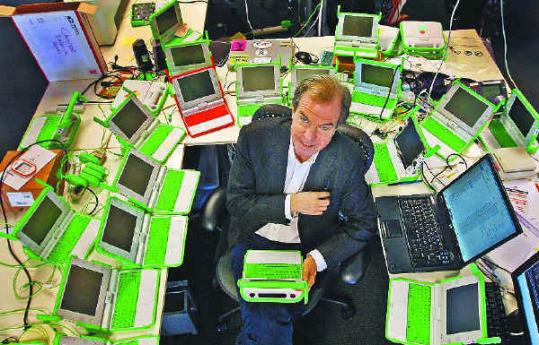 |
| The Man Himself |
 |
OLpC Program in Nigeria |
Secondly, when these laptops break down physically or their software malfunctions, children need teachers who have training on computer repair and maintenance. Too often these One Laptop per Child machines seem to be abandoned when they no longer perform adequately - which both robs the student of a machine that inspires and enables creativity and technological learning as well as shows inter/national organizations that their often extensive funding for such a project is misplaced. The only way that the OLpC program can work is for teachers to become computer mechanics, and pass this newfound knowledge onto their students.
Ultimately the issue at the forefront of improving education - especially in the tech world - is what it has always been: discovering how to inspire teachers to become more involved and effective, more knowledgeable and motivated to continue to learn and improve their own teaching methods. As such, Trucano was right to say that "the introduction and use of ICTs in education can be a useful tool to help promote and enable educational reform" (Knowledge Maps 2005) but that reform must be the end we seek in improving education in the developing world and throughout the globe.
To say that simply providing a new piece of technology is the end-all-be-all solution to the problems of the international education systems is to disregard the fact that without guidance and a network of support, technology will only prove as effective as children make it for themselves. Without discounting the wild - and often astonishingly inspirational - learning that students can do for and by themselves, why propose an educational world where teachers lose their place as guides along the trail of learning? Quite cynically, even if only to inspire students that they themselves can be better, more effective communicators and guides than their teachers are, isn't this enough of a reason to provide students with ever-learning and ever-improving teachers in the classrooms of the world?
So, in the end, the conversation over Negroponte's One Laptop per Child program and others of the sort rests with the fate of teachers, not students or children, and not even so much technology. Children will use whatever technology is at their disposal - and increasingly cell phones are bridging the gaps between those in the developing world and the rest. But to simply use a cell phone, or a laptop, is not enough of a victory for those truly passionate about educational reform. We must strive to use these technologies effectively to harness each child's natural fascination with and motivation towards learning. And not necessarily just for the sake of learning itself - when we see farmers using cell phones to make sure they are not cheated at the local market for their goods, or when we see children reading full-length novels and texts on the tiny screens, we are seeing evidence of technology's ability to improve the standard of living and the standard of imagination the world over.
But we can not be satisfied with simply giving a child a laptop and walking away. We must stand with that child and help them, encourage them, and ultimately learn from them.
The world needs great teachers - and local ones at that.
 |
| This is a good start - how about evident electricity and local teachers next? |

No comments:
Post a Comment